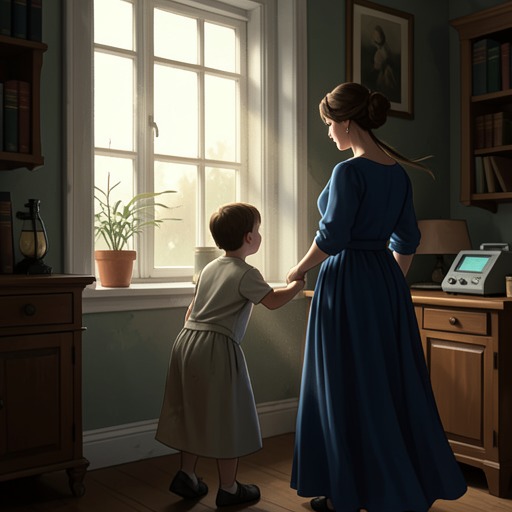
Josie’s house
Klara and the SunJosie’s house is the rural home where Klara’s life as Josie’s Artificial Friend takes shape. Far from the store and its carefully arranged displays, the house demands continual readjustment: its objects move, its rooms have to be learned through use, and care for Josie is bound to the changing conditions of family life. Its wide windows and open sky also make the Sun’s nourishment part of the household’s everyday rhythms.
Setting and Domestic Routine
The kitchen is initially difficult for Klara to navigate because Melania Housekeeper repeatedly moves things. A food blender, for example, changes position four times in a few minutes, forcing Klara to begin her observations afresh. The fixed Island at the kitchen’s center offers a counterpoint to that instability. Its pale brown, bricklike tiles, basin, and row of three high stools give the room an anchor. When Josie is still strong, she sits there to work on tutorials or sketch; Klara first feels awkward on a stool too high for her, then adopts Josie’s habit of setting her elbows firmly on the Island to feel secure.
The kitchen also organizes Klara’s attention around sunlight and Josie’s physical comfort. Large windows look toward a wide sky, distant trees, and a road rising over a hill; a skylight in the high ceiling can be opened or covered by remote. Klara initially worries when Melania Housekeeper draws the blind across the skylight while sunlight is entering. Watching Josie grow too warm teaches her that the Sun’s nourishment must be balanced against the danger of heat, and she learns to operate the remote herself when the Sun’s pattern becomes too intense over Josie.
Life in the house differs sharply from the store in its spatial and social order. Klara had been accustomed to finding smaller objects, including bracelets and an earrings box, kept in their proper places. At Josie’s house, Melania Housekeeper’s frequent rearrangements make that certainty impossible. Klara also finds the absence of traffic, passers-by, and other Artificial Friends disorienting: from windows overlooking the highway or fields, she sometimes searches for a distant AF before remembering how remote the house is from the city. She initially mistakes Melania Housekeeper for someone who will introduce her to her new life, follows her too closely, and is sharply told to get lost; Klara then understands that the housekeeper’s role is unlike the Manager’s.
Arrival and Care
Klara first meets Rick the week she sees Josie’s house from outside. On that first outing, Josie takes her out to settle an argument about how parts of the house connect. As the front door opens, Klara notices new air and sunlight entering the hall. Josie’s face is kind, but Melania Housekeeper steps between them and takes Josie’s arm, apparently judging that Klara is not yet familiar enough with the outdoors to protect her reliably. Klara follows the two of them from the loose stones by the house onto the hard road, concentrating on her footing and on the landscape she had previously known only from the bedroom window.
The house is also where Josie’s illness and the limits of Klara’s abilities acquire everyday significance. When Klara visits Rick’s home, Rick remarks on a smell and assumes smell matters for safety, especially in detecting fire. Klara explains that she has no sense of smell, perhaps because B3s have limited olfaction. The exchange makes clear that the companion’s attentive presence does not mean she can perceive every domestic danger through human senses.
Family, Neighbors, and Opportunity
Josie’s house sits within a small but consequential network of family and neighbors. When Josie insists that Rick be included in a gathering she is expected to host, her mother agrees and describes Rick as a good person and their neighbor. The house is thus not only a private setting for care but a point of contact with Josie’s friendships and the social pressures she faces. Klara interprets Josie’s sometimes strange conduct at an interaction meeting in light of Rick’s fear that she might become like the other children; she believes Josie remains kind underneath, while also recognizing the children’s fear of loneliness.
Rick’s educational prospects bring wider social exclusions to the doorstep. His mother explains that, although he was never lifted, Atlas Brookings accepts a small number of unlifted students and is the only proper college still to do so. Competition for the few places is severe. Rick is clever and could have a chance with expert guidance, but the family cannot find a tutor: TWE members are forbidden to tutor unlifted students, while other tutors demand fees they cannot afford. The disclosure places the house within a larger system of unequal access, where neighborly ties and family support matter but cannot by themselves remove institutional barriers.
Changing Futures and Significance
The house later becomes a place where different futures can be seen side by side. The Father praises Rick’s drone work as impressive and says that genuine ability should be noticed whether someone is lifted or not. Rick credits the Father with encouraging him and helping establish the foundations of his work, even as the Father modestly denies having contributed much. Their exchange shows how the household and its neighboring relationships can provide recognition and practical encouragement that formal systems withhold.
Near the end of Klara’s story, she reflects that Rick and Josie still show kindness to each other while preparing for very different futures. The contrast matters because the house has held them within a shared childhood world, but it cannot make their paths converge. Klara remembers asking the Father whether his love for Josie was genuine and everlasting, and now finds their separate plans troubling. The home’s significance therefore lies not in protecting its occupants from illness, exclusion, or separation, but in making care and connection tangible while those pressures continue.
The house also persists as an image shaped by Klara’s memory after she has been left at the Yard. In that later setting, she recalls crossing fields with Rick beneath a wide sky, while the Yard’s ordered rows of discarded machinery replace the changing, lived-in rooms of Josie’s home. The contrast links the house’s domestic routines to the book’s larger concerns with companionship, the conditions that sustain life, and what remains when a shared household world has passed.